


Did you know that creators who sell their own products earn, on average, more than 10 times what they make from ad revenue or brand deals alone? I didn’t believe it either — until I lived it.
Two years ago, I was posting content for free. Reels, blog posts, newsletters — pouring hours into stuff that got likes and comments but barely paid my grocery bill. Then I flipped the model. Instead of just creating content, I started turning every piece of content into a doorway to something I sold. A worksheet. A template. A digital guide. Within six months, that same content was generating over $3,500 a month — without me posting any more often than before.
That shift has a name: content-to-commerce. And if you’re a creator, blogger, or side-hustler who’s tired of “engagement” that doesn’t pay rent, this is the guide I wish someone had handed me two years ago.
In this comprehensive guide, I’ll walk you through exactly what content-to-commerce is, why it works so much better than ad revenue alone, and how to build your own content-to-commerce engine step by step — even if you’re starting with zero followers today.
What Is Content-to-Commerce, Really?
Let me break this down simply: content-to-commerce is the practice of using your content (blog posts, videos, social posts, newsletters) as the marketing engine for a product you actually own — instead of relying on ads, sponsorships, or affiliate commissions as your main income.

Here’s the difference that changed everything for me:
- Old model: Create content → get views → get paid pennies per thousand views (or wait around for a brand deal)
- Content-to-commerce model: Create content → build trust and demonstrate value → sell your own digital product directly to the people who already love your content
Big mistake I made early on: I thought I needed a huge audience before I could sell anything. I waited almost a year to launch my first product because I “didn’t have enough followers.” Boy, was I wrong about that. My first ebook sold to an email list of just 340 people. Small, engaged audiences convert far better than big, passive ones.
Pro tip: If you’re already creating content — even inconsistently — you’re already halfway to a content-to-commerce business. The missing piece is usually the “commerce” part, not the “content” part.
Why the Content-to-Commerce Model Works So Well
The creator economy has matured a lot. A few years ago, “make money online” mostly meant chasing ad revenue or begging brands for sponsorships. Today, the smartest creators are skipping the middleman entirely.

Here’s why this model has become my bread and butter:
- You own 100% of the profit. No platform algorithm decides your payout. No brand negotiates your rate down.
- Digital products scale infinitely. You create the product once; you can sell it 10 times or 10,000 times with zero extra production cost.
- Content becomes an asset, not a chore. Every blog post or video you make keeps selling for you long after you hit publish — it’s true passive income.
- Trust converts better than ads. People buy from creators they already feel connected to. Your content is your sales funnel.
- You control your income ceiling. With affiliate marketing, you’re capped by someone else’s commission rate. With your own product, there’s no cap.
Fast forward to today, and content-to-commerce is honestly the single biggest reason I was able to leave my 9-to-5. Let me show you how to build it.
Step 1: Pick a Content Format You Can Sustain
You don’t need to be everywhere. Trying to post on five platforms at once is the fastest way to burn out — trust me, I tried.
Pick one primary content channel to start:
- Blogging — great for SEO and long-term, evergreen traffic (this is my personal favorite for content-to-commerce)
- Short-form video (Reels, TikTok, YouTube Shorts) — fastest way to build an audience quickly
- Email newsletter — the highest-converting channel for actual sales, hands down
- Pinterest — massively underrated for driving traffic to digital products, especially in the lifestyle and finance space
Here’s what I learned the hard way: pick the format that matches your strengths, not the one that’s trendiest. I’m a writer, not a video person, so I built my whole content-to-commerce engine around blogging and email — and it’s still working for me years later.
Step 2: Choose Your “Commerce” — What Are You Actually Selling?
This is the part most people skip, and it’s the part that actually pays your bills. Your content should always be pointing toward something — even if that something is free at first (like an email opt-in) before it becomes paid.

Digital products that work beautifully with the content-to-commerce model include:
- Ebooks and guides — my personal go-to, since they’re low-cost to create and high-margin to sell
- Templates and printables — planners, worksheets, social media templates
- Online courses or mini-courses — great once you’ve validated demand with a smaller product first
- Membership or subscription content — recurring revenue, but harder to launch cold
- Digital toolkits — swipe files, prompt packs, checklists bundled together
Here’s what I learned the hard way: don’t try to build a course as your first product. It’s the highest-effort, highest-risk option. Start with something you can create in a weekend — an ebook or a template pack — validate that people will actually pay for it, then scale up.
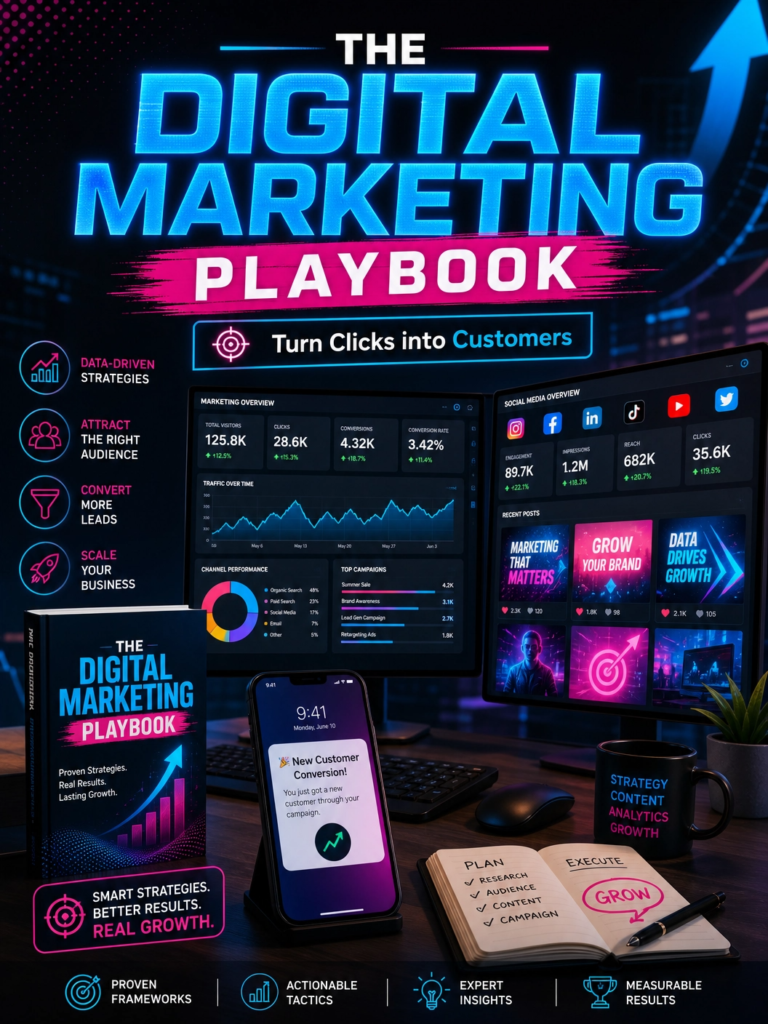
If you want a shortcut here, this is exactly the kind of question I get asked constantly, and it’s why I love pointing people toward The Digital Marketing Playbook — it walks you through turning content into customers across every channel: SEO, social, email, and paid traffic, so you’re not guessing which content-to-commerce path fits your business.
BUY NOW!
Step 3: Build the Content-to-Product Bridge
This is the step nobody talks about enough, and it’s the difference between content that entertains and content that sells.
Every piece of content you publish should do one of three things:
- Build trust — show your expertise or your results
- Solve a small problem — give a taste of the transformation your product provides
- Point toward the product — a natural, non-pushy call to action
Here’s a simple formula I use for almost every blog post or video:
Hook → Value (teach something real) → Soft pitch (“If you want the full system, I break it all down in [product]”) → Call to action
Let me share a real example. When I write a blog post about budgeting, I don’t just list tips — I include one or two specific numbers from my own budget, share a mistake I made, and then mention that my full budgeting system (spreadsheets, templates, the whole process) is laid out step by step in my guide. It’s not salesy. It’s just the natural next step for someone who’s already engaged.
Pro tip: Add a call-to-action at the end of your content and, if it fits naturally, one soft mention in the middle too. Don’t wait until the very last line to mention your product — some readers won’t scroll that far.
Step 4: Set Up Your Sales Infrastructure (Without Overcomplicating It)
I used to get nervous sweats thinking about the “tech side” of selling online. It’s genuinely simpler than you think.
Here’s the minimum viable setup:
- A simple sales page — you don’t need a fancy website, just one clear page per product
- A payment processor — Stripe or a platform like Gumroad/Payhip handles this for you
- An email list — this is non-negotiable; it’s your highest-converting sales channel
- A delivery system — most platforms auto-deliver digital files after purchase
Tools I actually use and recommend:
- Canva Pro ($119/year) — I use this for 90% of my product design and content graphics
- ConvertKit or MailerLite — for email marketing and automated sales sequences
- Gumroad or Payhip — beginner-friendly platforms to sell digital products with zero coding
Little did I know when I started that I didn’t need a custom website, a fancy funnel, or thousands of dollars in software. My first $1,000 month came from one blog post, one email sequence, and a $27 ebook.
Step 5: Drive Traffic That Actually Converts
Content-to-commerce lives or dies on traffic — but not just any traffic. You want people who are actually looking for a solution, not just scrolling for entertainment.
My favorite traffic sources for content-to-commerce, ranked by how well they convert:
- Email list — always my top converter; treat every subscriber like gold
- SEO/organic search — slower to build but compounds forever (this post you’re reading is part of that strategy!)
- Pinterest — incredible for driving warm, buyer-intent traffic to blog posts and products
- Short-form video — best for growing awareness and audience size fast
- Guest posts and collaborations — borrow someone else’s trust to build your own
Here’s the truth: most people fail at content-to-commerce not because their product is bad, but because they never built consistent traffic. Pick two channels max when you’re starting out, and go deep instead of wide.
Step 6: Track, Test, and Scale
Once your first product is live and selling, it’s time to optimize. This is where the real income growth happens.

Things I track every single month:
- Conversion rate — how many content readers become buyers
- Email open and click rates — a dropping number here usually means your content needs a refresh
- Top-performing content — double down on what’s already converting
- Customer feedback — this tells you exactly what your next product should be
Pro tip: Once you have one product selling consistently, create a second, complementary product. This is how you build a real content-to-commerce business instead of a one-hit product.
If you’re building out a full income strategy — not just one product, but a real system across content, community, and offers — I’d honestly recommend checking out ladybossincome.com/ebooks for guides that walk through the exact frameworks I use, from digital marketing to personal branding to AI-powered content creation.
Common Mistakes to Avoid
Before you go build your own content-to-commerce engine, let me save you some pain:
- Waiting for “enough” followers before selling — sell early, even to a small list
- Making your product too complicated — simple, focused products sell better than bloated ones
- Forgetting the call to action — great content without a clear next step leaves money on the table
- Ignoring your email list — social media platforms come and go; your list is yours forever
- Not pricing confidently — undercharging is the #1 mistake I see new creators make
Your Content-to-Commerce Action Plan
Building a content-to-commerce income stream isn’t complicated, but it does take consistency. Here’s your roadmap, one more time:
- Pick one content channel and commit to it
- Choose a simple digital product you can create fast
- Build the content-to-product bridge into everything you publish
- Set up basic sales infrastructure (sales page, payment, email)
- Drive focused traffic through 1–2 channels
- Track your numbers and launch product number two
Starting a content-to-commerce business can genuinely change your financial life — it changed mine. You don’t need a massive following, a big budget, or years of experience. You need one piece of content, one product, and the willingness to actually hit publish. Trust me, the version of you six months from now will be so glad you started today.






Leave a Reply