


Let me tell you about the plateau. You know the one. You’ve launched your print on demand shop, you’ve landed a few sales, and you feel that little rush every time a notification pings. Then… nothing much changes. A sale here, a sale there, and weeks that feel like you’re pushing a boulder uphill.
I lived on that plateau for a while, and honestly, it was frustrating. I kept thinking, “What am I missing?” Big mistake: I assumed the answer was “more designs, more listings, more everything.” Little did I know that scaling isn’t about doing more of everything. It’s about doing more of what already works, and building systems so you’re not trapped doing every task by hand.
In this comprehensive guide, I’ll walk you through how to scale your print on demand business in 2026. We’ll cover analyzing your data, doubling down on winners, expanding products, improving margins, building your brand, automating tasks, and growing beyond a single marketplace, all while using Printful and Printify to keep fulfillment running smoothly. (A quick and honest note: there are no guarantees in business, and results depend on your niche, effort, and market conditions. This is a framework, not a promise.)
What Does “Scaling” Really Mean?
Scaling means growing your revenue and profit without growing your workload at the same rate. In print on demand, that usually involves:
- Increasing traffic to products that already convert
- Raising your average order value with bundles and upsells
- Improving profit margins through better pricing and production choices
- Building repeat customers through email and brand loyalty
- Systematizing tasks so you can delegate or automate
Here’s the truth: scaling too early can backfire. If your products don’t yet sell, pouring in ad money or dozens of new designs won’t fix it. Make sure you have proof of demand first.

Step 1: Review Your Data and Find Your Winners
Before you change anything, look at what your numbers are telling you.
Metrics to review
- Best-selling products and designs
- Top traffic sources (Etsy search, Pinterest, social media, direct)
- Conversion rate by listing
- Average order value
- Profit per product after fees and production costs
- Return and complaint rates
Questions to ask
- Which designs get the most views and sales?
- Which niches or sub-niches perform best?
- Which product types (shirts, mugs, posters) convert best?
- Which keywords and traffic sources bring buyers?
Pro tip: Export your sales data monthly and keep it in a simple spreadsheet. Patterns become obvious when you can see them side by side.

Step 2: Double Down on What Works
The fastest way to grow is to build on proven success.
Ways to expand a winning design
- Create variations: Different colors, fonts, or layouts of the same concept.
- Move it to new products: If a design sells as a shirt, test it on a mug, tote, or poster.
- Build a collection: Related phrases or themes for the same audience.
- Target sub-niches: If “nurse” designs sell, try “ER nurse,” “pediatric nurse,” and “nursing student.”
- Add personalization: Names, dates, or locations.
Ways to expand a winning niche
- Study the community’s other interests and needs.
- Add seasonal or event-based designs.
- Create gift sets and matching items.
- Listen to customer messages and reviews for new ideas.
Here’s what I learned: one strong design turned into ten smart variations beats ten random new designs every time.
Step 3: Optimize Your Listings and SEO
Small improvements to your existing listings can create big gains, and they cost nothing but time.
Listing optimization checklist
- Refresh titles with stronger keywords and buyer-intent phrases.
- Use all available tags and swap out weak ones.
- Upgrade photos with lifestyle mockups and real sample images.
- Add short videos when possible.
- Improve descriptions with clear details, sizing, and shipping information.
- Fill in every attribute and choose the best categories.
- Update listings before peak seasons.
Pay attention to conversion, not just traffic
If a listing gets many views but few sales, the problem may be your price, photos, reviews, or description. If it gets few views, the problem is usually keywords and search visibility. Diagnose first, then fix.
Step 4: Improve Your Profit Margins
Growing revenue doesn’t help much if your margins are thin. Scaling smartly means protecting profit.
Ways to improve margins
- Compare providers: On Printify, you can compare print providers for the same product and choose the best balance of cost, quality, and speed.
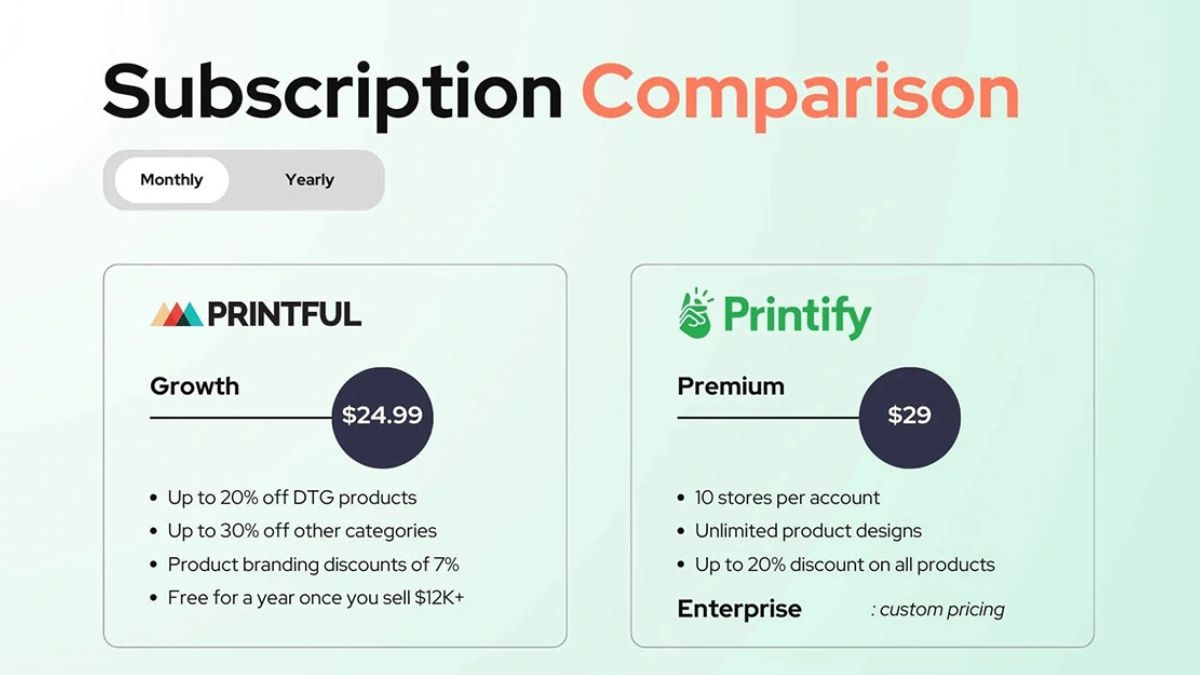
- Consider subscription plans: Both Printful and Printify offer optional paid programs that provide product discounts for higher-volume sellers. Check their sites for current terms and see whether the savings outweigh the cost at your order volume.
- Adjust your pricing: Test small increases on your best sellers. Many sellers underprice for too long.
- Reduce refunds and reprints: Better quality control and clearer listings help.
- Bundle products: Raise average order value without proportionally raising costs.
Choosing the right partner for each product
Not every product should come from the same place. A smart scaling strategy often uses:
- Printful for premium, brand-defining products where consistent quality, embroidery, or custom branding matter.
- Printify for variety, competitive base costs, and testing new products.
Using both gives you flexibility to protect quality on your flagship items while keeping costs down on volume products.
Step 5: Increase Your Average Order Value
It’s usually easier and cheaper to get existing customers to spend more than to find brand-new ones.
Proven ways to boost order value
- Bundles: “Coffee lover set” with a mug and tote bag.
- Matching sets: Family, couple, or team shirts.
- Volume discounts: “Buy 2, save 10 percent.”
- Free shipping thresholds: “Free shipping on orders over $X.”
- Personalization add-ons: Names or custom text.
- Upsell and cross-sell apps if you’re on Shopify.
Test one strategy at a time so you can see what actually moves the needle.
Step 6: Expand Your Traffic Sources
If most of your sales come from one place, you’re vulnerable to algorithm changes, policy updates, and competition. Diversify.
Free and organic channels
- Etsy SEO: Keep improving listings and adding relevant designs.
- Pinterest: Create fresh pins consistently. Pins can bring traffic long after posting.
- TikTok, Instagram Reels, and YouTube Shorts: Share design process, unboxings, and customer stories.
- Blogging and SEO: Publish gift guides and niche content that ranks on Google.
- Communities: Engage genuinely in Facebook groups and forums.

Email marketing
Email is one of the most valuable assets you can build. Offer a small discount or freebie in exchange for signups, then send:
- New collection announcements
- Seasonal reminders
- Exclusive offers
- Helpful niche content
Paid advertising
When you’re ready, test ads on proven products:
- Etsy Ads: Simple, marketplace-native promotion.
- Pinterest Ads: Good for gift and décor products.
- Meta Ads: Facebook and Instagram, often used for Shopify stores.
- Google Shopping: Useful for established stores.
Rules I follow: Start small, only promote products that already convert organically, track your return on ad spend, and never spend money you can’t afford to lose.

Step 7: Build a Real Brand
Commodity products compete on price. Brands compete on connection. Building a brand helps you charge more, earn loyalty, and stand out.
Branding elements to develop
- A memorable name and logo
- Consistent colors, fonts, and design style
- A clear brand story that explains who you serve and why
- A distinct voice in your descriptions and social content
- Professional packaging touches, such as branded packing slips and inserts where your platform supports them
Printful offers branding options like custom packing slips and, on select products, custom inner labels, which help your orders feel like they came from a real brand instead of a generic shop. You can explore those options by creating your Printful account.
Move toward owning your audience
Marketplaces are great, but you don’t own that audience. Consider opening a Shopify or website store to own your customer data and brand experience, while still selling on Etsy. Both Printful and Printify integrate with Shopify, WooCommerce, and other platforms, so expanding channels doesn’t mean changing partners.
Step 8: Systematize and Automate
The more you rely on memory and manual work, the harder it is to grow. Build systems.
Tasks you can systematize
- Design workflow: Use templates in Canva to create variations quickly.
- Listing creation: Create a listing template with your standard description, policies, and tags.
- Content creation: Batch photos, videos, and pins weekly.
- Customer service: Save reply templates for common questions.
- Order fulfillment: Let your POD platforms handle production and shipping automatically.
- Bookkeeping: Track income and expenses in one place each week.

Tasks you can delegate
- Graphic design: Freelance designers can produce unique artwork.
- Mockups and photography: Outsource or use templates.
- Pinterest management: A virtual assistant can schedule pins.
- Customer support: Hire help once volume grows.
- Listing optimization: A part-time assistant can refresh titles and tags.
Start with the tasks that drain the most time and the least creativity, and hand those off first.
Step 9: Manage Quality, Customer Service, and Reputation
Growth magnifies problems. If you have a quality issue with 10 orders, it’s annoying. With 1,000 orders, it’s a crisis.
Protect your reputation
- Order periodic samples of your best-selling products to confirm quality remains consistent.
- Monitor reviews and respond professionally.
- Handle defects quickly. Both platforms have reprint and refund processes for eligible issues, so know the policies well.
- Be transparent about production and delivery times.
- Keep a log of issues to spot repeating problems with a specific product or provider.
If a Printify provider starts causing frequent problems, switch to another provider for that product. If a product line needs stricter quality control, consider moving it to Printful. Having both accounts ready gives you a fast backup plan.
Step 10: Handle Business, Legal, and Financial Basics
As you grow, the boring stuff matters more. I used to get nervous sweats about this, but a little structure goes a long way.
Key areas to review
- Business structure: Many sellers form an LLC or equivalent as revenue grows. Ask a professional what fits your situation.
- Taxes and sales tax: Requirements vary by location and can change with sales volume. Consult a qualified accountant.
- Intellectual property: Keep records of your original designs and stay vigilant about trademarks.
- Separate finances: Use a dedicated business bank account and card.
- Reinvestment plan: Decide what percentage of profit goes back into growth.
(I’m not a lawyer or accountant, so please verify rules for your country and state.)

Step 11: Set Clear Goals and Track Progress
Scaling without goals is guessing. Set targets and review them regularly.
Sample goal framework
- Monthly revenue and profit targets
- Number of new designs or collections per month
- Traffic goals (views, visitors, email subscribers)
- Conversion rate targets
- Average order value goals
A simple monthly review routine
- Review sales, profit, and top products.
- Identify what worked and what didn’t.
- Choose 2 to 3 priorities for the next month.
- Delegate or automate one task.
- Plan seasonal content ahead.
Common Scaling Mistakes to Avoid
- Scaling before validating demand
- Adding too many products without a strategy
- Ignoring profit margins
- Relying on a single traffic source
- Neglecting quality control
- Overspending on ads too soon
- Burning out by doing everything yourself
Your 90-Day Scaling Plan
Days 1 to 30: Analyze your data, identify your top designs and niches, refresh your listings, and set up or upgrade your accounts with Printful and Printify.
Days 31 to 60: Expand winning designs into collections, add new product types, launch bundles, and build your email list.
Days 61 to 90: Test small ad campaigns on proven products, delegate a key task, and consider adding a Shopify store or another sales channel.
Take Your POD Business to the Next Level
Scaling a print on demand business isn’t about magic tricks or overnight explosions. It’s about paying attention to your data, doubling down on winners, protecting your margins, diversifying your traffic, and building systems that let your business grow without swallowing your life. The good news is that print on demand gives you a huge advantage: you can expand product lines and test new ideas without ever holding inventory.
To build a flexible, scalable foundation, put the right partners in your corner. Join Printful for consistent quality, branding features, and premium products, and join Printify for a wide catalog and competitive pricing options. Both are free to open, and together they give you the flexibility to grow on your terms. Review your numbers this week, pick one winning design to expand, and take the next step toward the business you’ve been dreaming about!









Leave a Reply