


A monthly sales goal can feel like a distant finish line — inspiring but vague. The difference between hoping for sales and actually hitting them is translating that monthly target into concrete, controllable weekly activities you can do, measure, and adjust.
This post shows a practical, step-by-step method to break sales goals into weekly actions that focus on leading indicators (what you control), weekly checkpoints, and quick adjustments. No promises of revenue or guaranteed conversion rates — only clear, realistic processes that help you move forward.
Why this matters for busy women entrepreneurs
- Monthly goals are useful for direction, but weekly actions create momentum.
- Weekly checkpoints reduce anxiety by making progress visible.
- Focusing on controllable activities keeps you accountable even when outcomes are uncertain.
What we’ll cover
- A simple 7-step method you can apply this week
- A detailed example for a freelancer selling coaching or services
- Common mistakes and how to fix them
- Three FAQs you’ll actually use
The principle: turn outcomes into controllable activities
Monthly sales goals are outcome goals (e.g., $6,000 in revenue this month). Outcomes depend on many factors you can’t fully control. The practical approach is to identify leading activities — actions that increase the likelihood of the outcome and that you can directly influence. Then plan those activities weekly, set checkpoints, and adjust based on what the data and your experience tell you.
The 7-step method to break sales goals into weekly actions
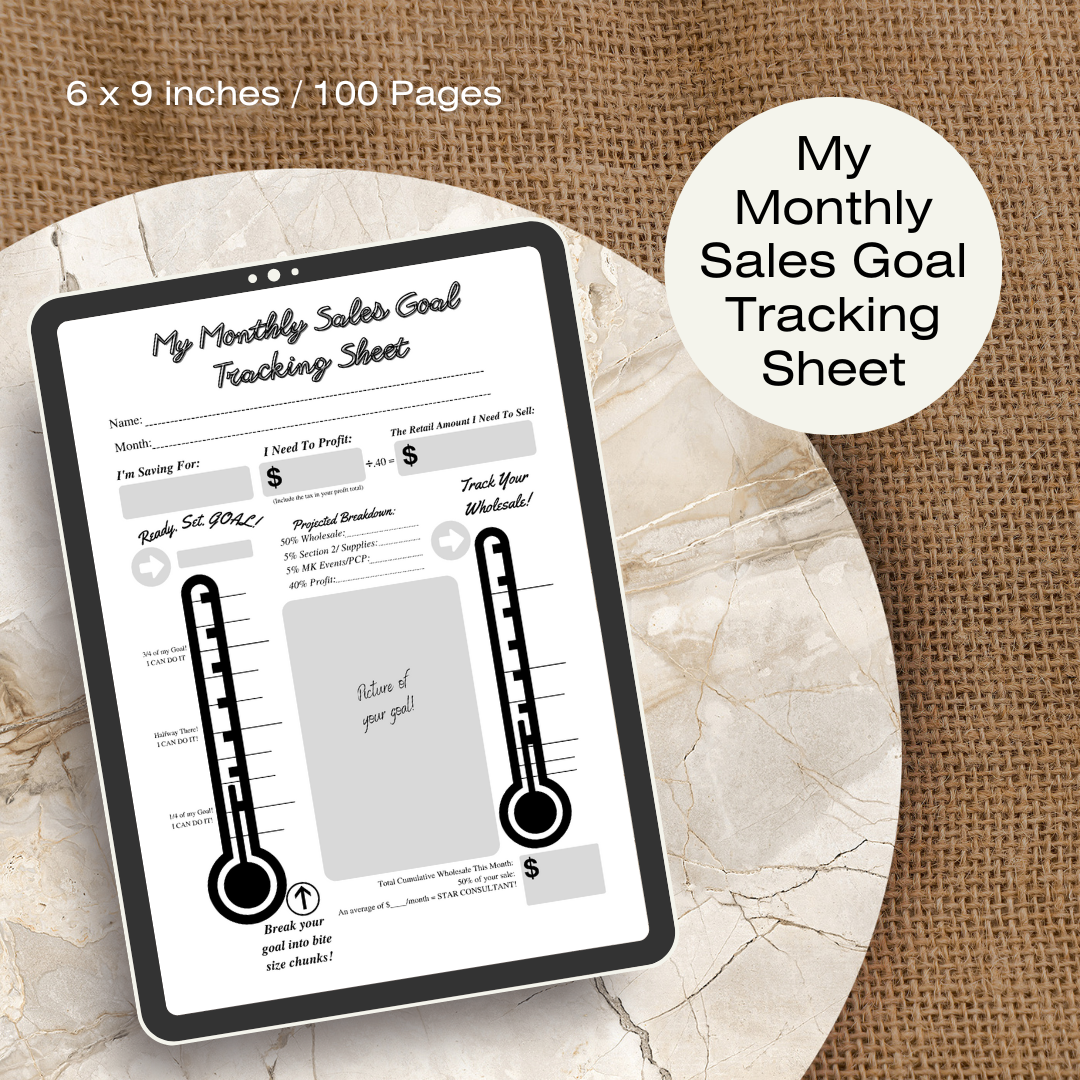
Follow these steps each month. Print or open a simple tracking sheet (I use templates like My Monthly Sales Goal Tracking Sheet — it’s an editable Canva template; details and availability are on its page) to record numbers and notes.
My Monthly Sales Goal Tracking Sheet / Editable Canva Template
- Choose one clear monthly outcome
- Be specific about the target. Example: “Book 8 client sessions” or “Sell 20 units of Product A.”
- Keep it realistic given your current business size and capacity.
- Identify the supporting conversion path
- Map the basic funnel: prospects → leads → sales conversations → closed sales.
- For many small businesses this is simple: outreach → discovery → proposal → closed sale.
- Estimate the typical conversion steps (as ranges, not promises)
- Use your past experience, even if rough: e.g., for every 10 discovery calls, 3 convert; for every 100 outreach messages, 5 reply.
- If you don’t have past data, pick conservative assumptions you can test.
- Calculate the weekly activity targets
- Divide the month into weeks. Convert the monthly outcome into weekly targets using your conversion assumptions.
- Example: To book 8 sessions in one month with a 25% discovery-to-booking rate, you need 32 discovery calls per month → 8 per week.
- Choose 3–5 leading activities to focus on each week
- Leading activities might include outreach messages, social media DMs, email sequences started, discovery calls offered, proposals sent, or paid ads monitored.
- Prioritize activities that fit your strengths and schedule.
- Set weekly checkpoints and simple metrics
- A checkpoint is a short review: Did you complete the weekly activity target? How many leads, replies, or calls did you get?
- Record raw numbers and one quick insight (what worked, what didn’t).
- Adjust the next week based on evidence
- If you hit activity targets but conversion is low, tweak messaging or qualification.
- If you missed activity targets, reduce the activity mix to what you can reliably do and consider time-blocking or batching.
- Keep changes small and deliberate so you can evaluate impact.
One-page weekly checklist (practical template)
- Weekly target (e.g., 8 outreach messages)
- Activities (tick boxes): Outreach sent, DMs replied, Calls scheduled, Proposals sent, Follow-ups sent
- Checkpoint numbers: Replies, Calls held, Proposals, Sales
- Quick note: What to change next week

Detailed example — freelance copywriter aiming for 4 new clients this month
Scenario: You’re a freelance copywriter who wants to break the monthly goal of 4 new clients into weekly actions.
Step 1: Monthly outcome
- Goal: 4 new clients this month.
Step 2: Conversion path
- Outreach → Discovery call → Proposal → Client signs
Step 3: Estimate conversions (conservative)
- Outreach to reply: 10% (1 reply per 10 outreaches)
- Reply to discovery call booked: 50%
- Discovery call to signed client: 40%
Step 4: Calculate weekly targets
- To sign 4 clients this month you need about 10 discovery calls (4 / 0.4 = 10).
- To book 10 discovery calls and assuming 50% who reply book calls, you need 20 replies.
- To get 20 replies at 10% reply rate, you need 200 outreaches per month → 50 outreaches per week.
Step 5: Choose 3–5 leading activities
- Activity 1: Send 50 tailored outreach emails/DMs each week (batch in two sessions).
- Activity 2: Publish 2 short social proof posts or case-study clips per week.
- Activity 3: Follow up on all replies within 24 hours (aim to convert to calls).
- Activity 4: Hold scheduled discovery calls and send proposals within 48 hours.
Step 6: Set checkpoints
- Weekly numbers to track: Outreach sent, Replies, Calls booked, Calls held, Proposals sent, Clients signed.
- Example week 1 numbers: Outreach 50, Replies 4, Calls booked 2, Calls held 2, Proposals 1, Clients signed 0.
Step 7: Adjust
- If you’re getting fewer replies than assumed, review subject lines, personalization level, and targeting. Maybe reduce the outreach size and make each message more tailored.
- If you’re getting calls but few signings, refine your pitch or qualifying questions and test offering a small low-risk package to increase conversions.
Notes on realistic adjustments
- If 50 outreaches/week is unsustainable, scale back to 25 highly-targeted messages and pair with a paid small test or referral ask. Smaller volume plus higher quality can be more effective than large-volume spray-and-pray.
Quick example for a product seller (small batch maker)
Scenario: You want to sell 40 units in a month.
- Conversion path: impressions → visits → cart adds → purchases
- Estimate: 2% conversion rate from visits to purchases (conservative placeholder)
- To sell 40 units, you need 2,000 visits per month → 500 visits/week.
- Leading activities: run 2 targeted social posts/week, send 2 newsletters, run a small influencer collaboration each week, and optimize one product page.
- Checkpoints: weekly visits, add-to-cart rate, purchase conversions, revenue.
- Adjust: if visits are there but purchases aren’t, test product photos, descriptions, price, and checkout friction. If visits are low, increase outreach or ad test.
Common mistakes (and how to fix them)
Mistake 1: Setting vague monthly outcomes
- Fix: Make the outcome concrete and measurable. “Increase revenue” becomes “generate $3,000 in new client revenue this month.”
Mistake 2: Focusing only on outcomes, not leading actions
- Fix: Choose specific activities that directly influence the funnel stage you control (outreach, follow-ups, call slots).
Mistake 3: Overloading your weekly plan
- Fix: Limit to 3–5 repeatable activities. Consistency beats sporadic bursts.
Mistake 4: Skipping checkpoints until month-end
- Fix: Use weekly checkpoints to detect small signs of trouble early and avoid scrambling near month-end.
Mistake 5: Ignoring the quality of leads
- Fix: Track where your replies and bookings are coming from and double down on channels that provide better-fit potential clients.
Mistake 6: Treating conversion assumptions as facts
- Fix: Treat these as hypotheses to test. Record actual conversion numbers and update calculations for next month.

How to keep it sustainable (time management and mindset)
- Timebox your weekly activities. Decide two blocks per week for outreach/batching and one short block for follow-ups and proposals.
- Use templates for outreach and follow-up but personalize 1–2 lines per prospect — personalization converts better than generic copy.
- Automate small repetitive tasks: scheduling links, followup reminders, and canned proposal templates free up decision energy for persuasion work.
- Celebrate weekly wins, not just the final number. Hitting activity targets matters and builds momentum.
Small checklist to run each week
- Review your monthly outcome and weekly targets.
- Complete your 3–5 leading activities.
- Log checkpoint numbers and one lesson learned.
- Decide one small tweak for next week.
- Schedule time for next week’s activities.

Three FAQs
Q1: What if I don’t have any historical conversion data?
- Start with conservative assumptions you can mentally live with and treat them as hypotheses. Run the weekly method for one month, track results, and use the real numbers to refine next month’s plan.
Q2: How do I choose leading activities that actually scale?
- Pick activities tied to specific funnel stages you can influence. Outreach, warm introductions, follow-ups, and content that prompts direct action are often scalable. Prioritize ones that align with your strengths and can be repeated without burning out.
Q3: How many weeks should I track before changing my whole approach?
- Give a new approach two-to-three weeks to collect meaningful data, unless the first week reveals a clear mismatch (for example, zero replies from an obviously targetable audience). Make small iterative changes rather than sweeping pivots.

Wrap-up — make the monthly goal real by weekly doing
A monthly sales goal only becomes achievable when you translate it into weekly, controllable actions. Use conversion assumptions as starting points, choose focused leading activities you can sustain, check progress weekly, and adjust deliberately. Over time you’ll replace guesses with real data and build a reliable rhythm that powers consistent progress.
If you want a ready-made place to record your monthly outcome, weekly activity targets and checkpoints, consider My Monthly Sales Goal Tracking Sheet — it’s an editable Canva template; see the product page for details and availability.
You don’t need overnight miracles. You need weekly actions you can control, measure, and improve. Start this week: pick one monthly outcome, calculate the first week’s leading activities, and schedule your first checkpoint.










Leave a Reply