


You don’t need an ocean of charts or a finance PhD to know whether your business is moving forward. A light, focused monthly business review for small business can keep you on track, reduce overwhelm, and turn vague hopes into clear next steps—without getting lost in spreadsheets.
Running a monthly business review becomes especially helpful when you’re a solopreneur, freelancer, or running a side hustle. You’re juggling client work, marketing, invoices, and life—so the review should be quick, meaningful, and easy to repeat. Below is a practical method you can finish in 60–90 minutes each month that prioritizes what matters: priorities, key activity measures, bottlenecks, experiments, and clear commitments for next month.
Why a light monthly review works
- It’s realistic. As a solo operator you don’t have time for large-scale reporting.
- It’s action oriented. The point is to change what you’ll do next month, not to admire last month’s numbers.
- It keeps focus. Regular small checks prevent tiny issues from becoming disasters.
How to use this guide
- Schedule a 60–90 minute block at the end of each month (or the first business day of the next month).
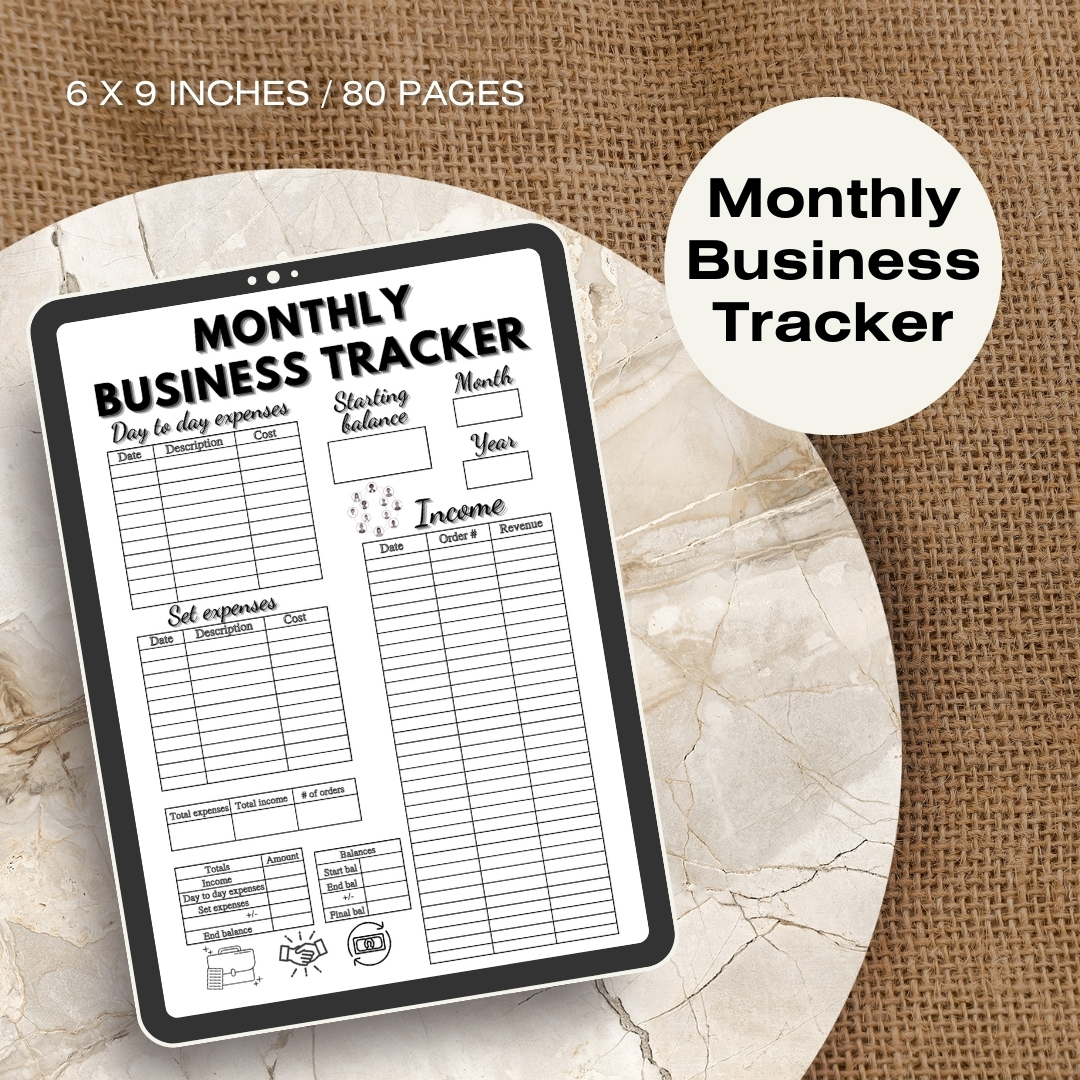
- Use a single page or simple template—paper, note app, or an editable Canva template like the Monthly Business Tracker—to capture your notes, so everything lives in one place. (Details and availability are on the product page.)
- Repeat and refine. This process is lightweight so you’ll actually do it.
The core monthly review framework — five fields that matter
Keep your review to these five sections. Each one answers a simple question and produces a short, usable output.
- Priorities: What was my top focus last month?
- Question: What was the most important thing you promised yourself you’d do?
- Output: One sentence stating whether you completed it, partly completed it, or didn’t start it, plus a one-line reason why.
- Why it matters: Priorities align your decisions. If you’re always chasing new tasks, the priority field forces accountability.
- Key activity measures: What I tracked (not dozens of metrics)
- Question: Which 3–5 activities most directly influence income and growth for your business?
- Output: A small table or bullet list of those activities with last month’s actuals and a one-line interpretation.
- Examples: Number of client proposals sent, number of discovery calls booked, number of product launches, number of blog posts or emails sent (if content drives sales for you), number of new leads.
- Why it matters: For many micro businesses, activity beats vanity metrics. Track the actions that lead to sales.
- Bottlenecks and issues: What blocked progress?
- Question: What repeated problem slowed your business down or created friction?
- Output: 1–3 named bottlenecks and their root cause (one sentence each).
- Why it matters: Naming a bottleneck makes it fixable.
- Experiments and learnings: What did I try and what did I learn?
- Question: What one experiment did you run? What happened?
- Output: A one-line summary of the experiment, one result sentence, and whether you’ll continue, modify, or stop it.
- Why it matters: Small, cheap experiments are how solo businesses evolve without huge risk.
- Next-month commitments: What I will actually do next month
- Question: What three commitments will lead to the most meaningful progress?
- Output: Three specific, time-bound commitments (e.g., “Send 8 proposals; schedule 10 discovery calls; publish one lead magnet page by week 3”).
- Why it matters: Clear commitments replace vague to-do lists.

A practical, numbered method you can use today
Do this in order. Time estimates assume 60–90 minutes total.
- 0–10 minutes: Quick context sweep
- Open your simplest source of truth (calendar, payment history, or project list).
- Jot down three words that describe last month (e.g., “busy, scattered, promising”).
- 10–25 minutes: Fill the Priorities field
- Write the priority you set last month. If you didn’t set one, choose what would have mattered most.
- Answer: Completed / Partly / Not started. Add one sentence why.
Tip: Keep priorities narrow—one top priority only. If two feel equal, pick the riskiest one. - 25–45 minutes: Capture Key Activity Measures
- Choose 3–5 activities that actually create value in your business. Examples below.
- For each activity: write last month’s count, the target (if any), and a one-line note on trend.
- If you use revenue as a metric, keep it as one line: revenue last month, and whether it met cash needs.
- 45–60 minutes: Name Bottlenecks and Quick Fixes
- Write 1–3 bottlenecks. For each, note: how it showed up, probable cause, one immediate next step to test.
- Example: “Bottleneck: Discovery calls often no-shows. Cause: calendar link time zone confusion. Quick fix: add time zone instructions and confirmation SMS.”
- 60–75 minutes: Log Experiments and Learning
- List experiments you ran (A/B subject lines, pricing change, free webinar).
- Record a short outcome and whether you’ll continue, stop, or modify.
- Decide one new experiment for next month that is cheap and fast.
- 75–90 minutes: Set Next-Month Commitments and Schedule
- Create three commitments that are specific, measurable, and time-bound.
- Drop them onto next month’s calendar. Add reminders and a 30-minute mid-month check-in.
Detailed example — a freelancer’s monthly review (realistic, simple)
Meet Priya, a freelance graphic designer who also sells a small set of templates. Her monthly business review looked like this:
Priorities
- Priority last month: Convert newsletter subscribers into paying template buyers.
- Status: Partly completed. Sent one promotional email but didn’t create a dedicated sales page.
- Why: Promotional email went out, but the sales page was deprioritized during client deadlines.
Key Activity Measures
- Client proposals sent: 6 (target 8) — Trend: down due to heavy client work.
- Discovery calls booked: 2 (target 4) — Trend: stable but low.
- Newsletter emails sent: 1 (target 2) — Trend: inconsistent.
- Template sales: 4 (target 10) — Trend: slow; sales spike after targeted emails.
Bottlenecks and issues
- Bottleneck 1: No sales page → friction for converting email clickers.
- Fix: Block 2 hours this month to finish a simple landing page.
- Bottleneck 2: Fewer proposals being sent because she didn’t prioritize prospecting.
- Fix: Schedule two weekly prospecting blocks of 60 minutes.
Experiments and learnings
- Experiment: Sent a personalized subject line variation to 200 subscribers.
- Result: Higher open rate but no sales increase.
- Decision: Continue testing subject lines; next test will include a clearer CTA and a time-limited discount.
Next-month commitments
- Finish and publish a simple sales landing page by week 2.
- Schedule two weekly prospecting blocks on the calendar for client outreach.
- Send two promotional emails—one with a clear CTA and limited-time offer.
Priya copies this into her Monthly Business Tracker (an editable Canva template) so she has the fields pre-structured each month. Details and availability are on the product page.

Examples of meaningful activity measures by business type
Not every business needs the same metrics. Pick the three that most directly create customers.
- For service providers: proposals sent, discovery calls booked, conversion rate from call to client.
- For product sellers: product page visits, abandoned cart recoveries, sales by channel.
- For coaches/consultants: discovery calls, sessions delivered, follow-up sequence conversion.
- For digital creators selling low-ticket items: email list growth, email opens leading to clicks, sales per email.
- For side-hustlers doing occasional gigs: gigs booked, average gig value, client repeat rate.
Common mistakes and quick fixes
Mistake 1: Trying to track every metric.
- Fix: Stop at 3–5 activity measures. Ask: “Which actions make money or move people to buy?”
Mistake 2: Making the review a data dump.
- Fix: Use the five-field framework. Each field must lead to one action.
Mistake 3: Vague commitments like “work on marketing.”
- Fix: Use time-bound commitments: “Publish one Instagram carousel on Wed and one email on Friday.”
Mistake 4: Skipping the experiment log.
- Fix: Experiments are learning. Even failed experiments tell you what not to keep doing.
Mistake 5: Not calendarizing commitments.
- Fix: Block the tasks on your calendar immediately during the review.
How to keep the review sustainable month to month
- Keep the format consistent. Repetition reduces friction.
- Use a template. An editable Canva template like the Monthly Business Tracker gives you a ready layout to fill in; see the product page for details.
- Celebrate small wins. If a customer rebooks or an email leads to a sale, note it. Momentum matters.
- Make it social if helpful. Occasionally review with a peer or accountability partner to stay motivated.
- Review only what changed. If a habit is steady and working, note it briefly and move on.

When to do a deeper review
A light monthly review is great for steady months. Do a deeper dive when:
- Revenue dips unexpectedly for two consecutive months.
- You pivot offerings or add a new revenue stream.
- You’re preparing for a big launch or an investment decision.
FAQs
Q: How long should a monthly business review take?
A: Aim for 60–90 minutes. The first few times might take longer as you find your rhythm. After that, you can complete the review in an hour.
Q: Which tools should I use for the monthly review?
A: Use what you already have: a simple note app, one Google Sheet for raw numbers, a calendar for scheduling. If you prefer a designed layout, consider an editable Canva template like the Monthly Business Tracker—the page lists details and availability.
Q: What if I don’t hit my commitments?
A: That’s normal. In the next review, note why you missed them and choose smaller, more realistic commitments or rearrange your schedule. Accountability improves follow-through.
Quick checklist to run your review (printable)
- Block 60–90 minutes on the calendar.
- Grab last month’s calendar, invoices, and inbox filter for key activity data.
- Fill: Priorities, Key Activity Measures, Bottlenecks, Experiments, Next-Month Commitments.
- Drop commitments into next month’s calendar.
- Set one mid-month check-in (15–30 minutes).

Your monthly review should clear fog, not add it
The goal of a monthly business review for small business is clarity, not complexity. Use this lightweight approach to stay honest about priorities, track the few actions that create value, fix bottlenecks quickly, learn from small experiments, and commit to concrete next steps. With consistency, these 60–90 minutes will keep your business moving forward without drowning you in spreadsheets.
If you’d like a ready layout to make the review even faster, check out the Monthly Business Tracker—an editable Canva template that gives you a single place to capture these fields. Details and availability are on its product page.










Leave a Reply