


The first month I earned real money from home, I did something that surprised me: I sat down with my calendar and realized that two hours of childcare a week would let me earn more than the childcare cost. It felt almost silly. For years I’d told myself that paying someone to watch my kids while I worked “from home” didn’t make sense. Then I did the math, and everything changed.
If you’re building an online income while raising kids, childcare is often the hidden lever. A few hours of consistent, uninterrupted time can multiply what you earn. And there may be tax benefits that help offset the cost, which many self-employed moms don’t realize they can claim.
Recent federal law changes made these benefits more generous. The Child and Dependent Care Credit now covers up to 50% of qualifying expenses, up from 35%, with the percentage depending on income and never falling below 20%. The dependent care FSA household limit rose to $7,500. The Child Tax Credit is $2,200 per qualifying child and is now permanent. The details are important, and the rules for self-employed moms are different from those for employees.
In this guide, I’ll explain childcare costs and tax credits for moms who work online: how the credits work, what counts, how self-employment fits in, and a practical way to plan. (I’m not a tax professional, and rules depend on your situation. Please check the IRS website or a qualified preparer before relying on this.)
Why Childcare Can Be a Smart Business Investment
Think of childcare as a tool that unlocks focused work:
- Deep work needs quiet time. Writing, creating, calling clients, and learning are hard with interruptions.
- A few protected hours can raise your income, especially if your work pays well per hour.
- It reduces burnout. Surveys of side hustlers often report high rates of burnout, and consistent childcare time can help.
- It can be partly offset by tax benefits if you meet the rules.
You don’t need full-time care. Even a part-time preschool, a mother’s helper, a babysitting swap, or a few hours at a childcare center can make a real difference.

Key Point: You Need Earned Income
The Child and Dependent Care Credit is for care that allows you (and your spouse, if married) to work or look for work. In general:
- Earned income is required. Wages and net earnings from self-employment can count. Investment income and some other income types generally don’t.
- If you’re married, both spouses generally need earned income, with exceptions such as a spouse who is a full-time student or unable to care for themselves. Check the IRS rules for your situation.
- Your side hustle income can count, but only the net earnings from self-employment, and you must report it properly.
If you’re not yet earning from your online work, the credit may not apply yet. Keep track as your income grows.
The Child and Dependent Care Credit (The Basics)
From IRS guidance:
- Qualifying person: typically a child under age 13 who lives with you for more than half the year, or a spouse or dependent who can’t care for themselves.
- Qualifying expenses: care while you work or look for work, such as daycare, preschool, before- and after-school programs, a nanny, or day camp. Overnight camp doesn’t count. Tuition for kindergarten and higher grades generally isn’t a qualifying expense.
- Expense limits: up to $3,000 for one qualifying person or $6,000 for two or more.
- Credit percentage: between 20% and 50% of those expenses, depending on your adjusted gross income. Lower- and middle-income families generally get a higher percentage.
- Maximum credit: up to $1,500 for one qualifying person or up to $3,000 for two or more.
- Nonrefundable: the credit reduces tax you owe but isn’t paid out as a refund beyond that.
You’ll need the care provider’s name, address, and taxpayer identification number (such as a Social Security number or employer ID) to claim the credit. Ask for this when you hire someone, and keep receipts.

The Dependent Care FSA (If You Have an Employer)
If you or your spouse works for an employer that offers a dependent care FSA:
- The household limit is up to $7,500, or $3,750 if married filing separately. Your employer must have adopted the higher limit, so ask.
- Contributions are pre-tax.
- It’s per household, so couples need to coordinate.
- Elections are usually locked for the plan year unless there’s a qualifying life event, and unused money may be forfeited under plan rules.
- You can’t use the same expenses for both the FSA and the credit. Every dollar through the FSA reduces the expenses available for the credit.
Important for self-employed moms: if you’re self-employed, you typically don’t have an employer FSA. The credit is your main tool. If your spouse has an employer FSA, compare the options together.
FSA vs. Credit: Quick Guidance
- Higher-income households often benefit more from the FSA, because excluding income from tax can beat a credit of 20%.
- Lower- and middle-income households may benefit more from the credit, especially with the higher credit rate.
- It depends on your tax bracket, expenses, and number of children. Run both scenarios or ask a tax professional.

The Child Tax Credit (A Separate Benefit)
The Child Tax Credit is different from the care credit. It’s $2,200 per qualifying child under 17, and a portion may be refundable. It phases out at higher incomes. A valid Social Security number for the child is required. You can generally claim it whether or not you pay for childcare.
What About 529 Plans?
Daycare and preschool generally aren’t qualified 529 expenses. Recent changes expanded qualified K-12 spending, with up to $20,000 per student per year for items like tuition, tutoring, and certain other costs. Check your plan’s rules and your state’s tax treatment.
Planning Your Childcare as a Work-From-Home Mom
- Decide how many focused hours you need. Match them to your income goals.
- Price your options: a part-time preschool, a mother’s helper, a babysitting swap, a coworking space with childcare, or help from relatives.
- Estimate your annual childcare costs and see how they compare to the credit limits.
- Track your business income so you can show earned income.
- Get proper documentation: provider details and receipts.
- Pay in a traceable way: checks, bank transfers, or other methods that create a record.
- If you hire a nanny or babysitter in your home, ask a tax professional about household employer rules, since you may have tax and reporting responsibilities.

Quarterly Taxes and the Bigger Picture
If you’re self-employed, you may owe estimated taxes during the year. Many tax professionals suggest setting aside roughly 25% to 30% of your net earnings, but your situation may differ. The care credit reduces your tax bill, but it doesn’t remove self-employment tax, so plan accordingly. In the U.S., net earnings of $400 or more trigger self-employment tax.
Mistakes to Avoid
- Claiming the credit without earned income.
- Counting overnight camp or school tuition.
- Double-counting expenses with an FSA.
- Missing the provider’s taxpayer ID.
- Paying in cash with no records.
- Assuming your employer adopted the higher FSA limit.
- Forgetting that a nanny may create employer tax responsibilities.

Your 7-Day Childcare Planning Checklist
- Day 1: Decide how many focused work hours you need each week.
- Day 2: List childcare options and their costs.
- Day 3: Check whether you or your spouse has an FSA option.
- Day 4: Gather provider details for any care you already pay for.
- Day 5: Set up a simple system to track business income and care expenses.
- Day 6: Estimate your potential credit using the IRS guidance, or book time with a tax preparer.
- Day 7: Decide your first step, even if it’s just two hours of help a week.
Build Childcare Into a Bigger Plan
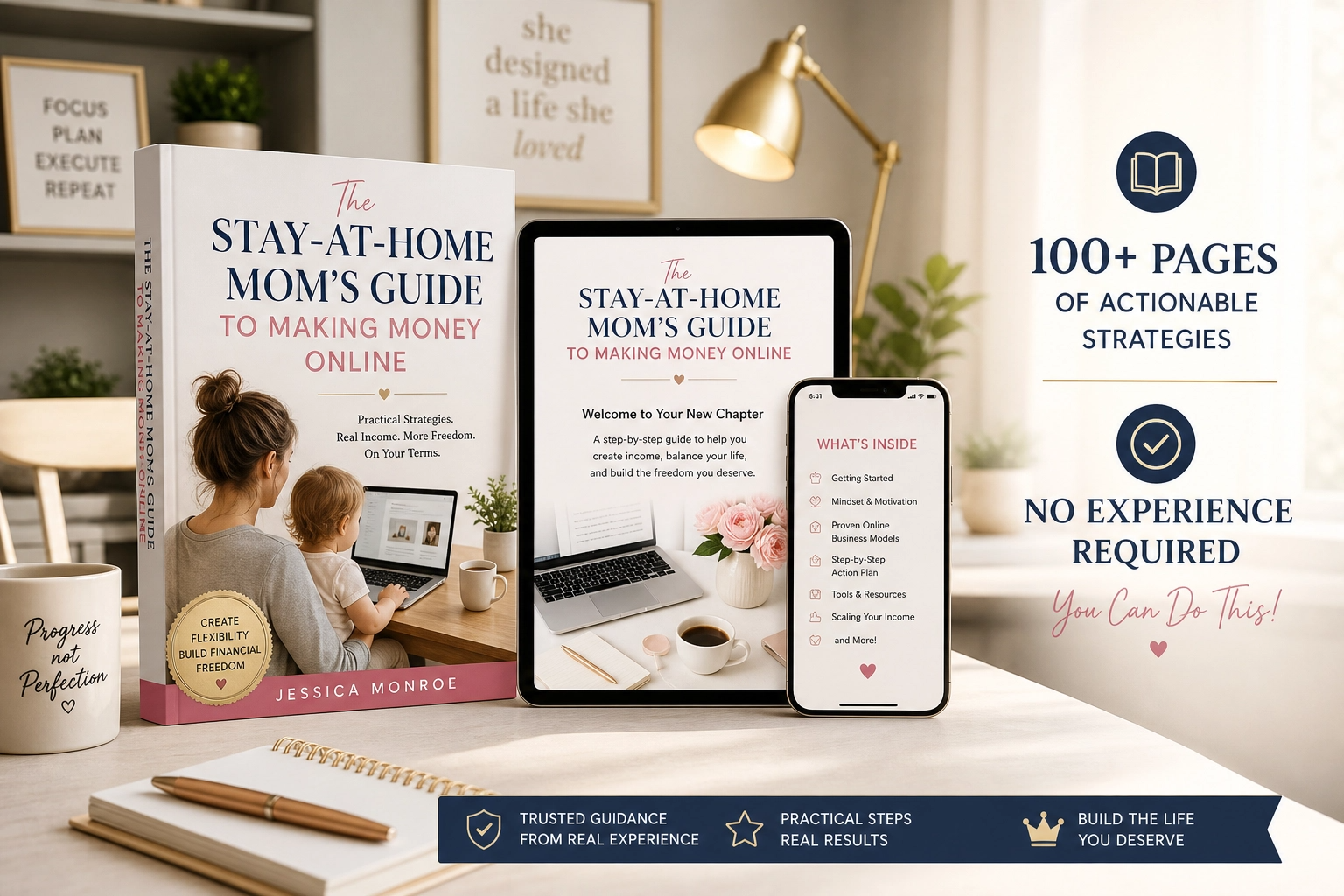
Time is one of your biggest assets as a working mom. If you’d like a beginner-friendly roadmap made for moms, take a look at my ebook:
The Stay-At-Home Mom’s Guide To Making Money Online
Trust me, protecting your work time is one of the smartest moves you can make.
Final Thoughts
For many moms, a few hours of childcare can make the difference between a hobby and a real income, and tax benefits may help soften the cost. Understand the earned income requirement, keep good records, compare the credit and any FSA, and ask a professional when in doubt. You’re not being selfish by investing in time to work. You’re building something for your family.










Leave a Reply