

There’s a moment every personal brand hits where you realize something slightly scary: the whole business is you. Your face, your voice, your inbox, your late-night edits. If you got sick for a month, what would happen to your income? When I first asked myself that question honestly, I felt a little queasy. And then I felt motivated.
That same question is quietly reshaping the creator world right now. In the first days of October 2026, a major talent agency launched an in-house creator operations unit, a live-events giant backed a company built to acquire creator-management firms, a pro gamer turned creator launched a holding company with an outside CEO, and a podcast host took full ownership of his show. Alongside that, brands and platforms are building tools to work with creators at scale.
In this guide to turning a personal brand into a business, I’ll explain what’s happening, why it matters even if you have 500 followers, and a practical checklist for building assets that don’t depend on you doing everything forever.
What Happened in the First Week of October
According to the Creator Economy Brief published on October 5, 2026:
- WME launched Creator Labs (Oct 2). The agency created an in-house unit handling channel management, syndication, and distribution for clients, and took a stake in video operations firm Astra Media.
- Live Nation backed Creator Nation (Oct 1). The new company aims to acquire creator-management firms and sell services a la carte.
- Cody “Clix” Conrod launched Full Box Inc. (Oct 2), structured with an outside CEO, three operating companies, and a ventures arm.
- Guy Raz took full ownership of How I Built This from NPR (Oct 1), with sales and distribution handled by Vox Media.
- Platforms moved up the stack. Meta’s Creator Marketing Hub (announced September 15) combines its creator marketplace and partnership ads, and Instagram live video ads followed on September 29.
The brief described this as the middle of the creator business being squeezed: talent representatives are moving into day-to-day operations while platforms move into brand-deal making. Investors are also paying attention, with venture firm Slow Ventures disclosing several creator investments this year.
Here’s the truth: the creator world is maturing from “people posting content” into “people running businesses.”
Why This Matters for Small Personal Brands
You might be thinking, “I’m not a celebrity with an agent.” Fair. But the lessons scale down perfectly:
- Ownership matters. The big names are buying back control of their content, distribution, and operations. You can start by owning your email list, website, and customer relationships.
- Operations are a business, not a side task. Editing, scheduling, invoicing, and brand outreach can eat all your time. Systems and helpers free you to do the one thing only you can do.
- Multiple income streams reduce risk. Holding companies often include several operating companies. For you, that might mean services, digital products, and sponsorships.
- Key-person risk is real. One roundup of personal branding statistics cites an executive survey claiming that a large share of a company’s market value is tied to the CEO’s reputation (treat that figure as directional). If your income depends entirely on you, the business is fragile.
Branding analysts have also described a shift in 2026 from personal branding as performance toward ownership and real relationships, with followers becoming collaborators and communities replacing simple audiences.
The Personal Brand Business Checklist
Here’s how I think about turning a personal brand into something sturdier. Check how many you already have.
Audience assets (you own the relationship)
- An email list or community you control
- A website with your name and a clear offer
- Backed-up content (originals, raw files, transcripts)
- Claimed handles on major platforms
Offer assets (you earn from more than one thing)
- At least one service people pay for
- At least one product or resource that sells without you
- A simple pricing page or offer sheet
- A way to earn from partnerships or affiliates, if it fits your audience
Operations assets (the business runs without chaos)
- A separate business bank account
- A simple system for tracking income, expenses, and invoices
- Written contract templates for client and brand work
- A content calendar and repeatable workflow
- A list of tasks you could delegate
People and proof assets
- A “proof pack” with case studies and testimonials
- A short list of trusted collaborators (editor, assistant, accountant)
- A mentor or peer group
Protection assets
- Clear ownership of your content and brand name
- Awareness of trademark or business registration options in your country (ask a professional)
- Likeness and account security: strong passwords, two-factor authentication, impersonation alerts
I’m not a lawyer or accountant, so please get qualified advice for contracts, taxes, and trademarks.
What to Look For (and Question) in Offers From Agencies and Investors
As agencies, funds, and platforms compete for creators, you may eventually hear offers to manage your channel, take a stake in your brand, or share revenue. Some will be great. Before you sign anything:
- Who owns your content, channel, and audience?
- What happens if you leave?
- How is revenue shared, and what’s included in the “cut”?
- How long is the exclusivity?
- Do you keep control of your accounts?
- Get an independent lawyer to review significant agreements.
Pro tip: If an offer pressures you to sign quickly, that’s a reason to slow down.
A Beginner-Friendly Business Roadmap
Phase 1: Clarity (Weeks 1-2)
Write your one-sentence promise, your ideal customer, and your first offer. Decide what you will and won’t do.
Phase 2: Foundation (Weeks 3-6)
Set up your website, email list, simple payment method, and tracking spreadsheet. Draft a basic contract and invoice template.
Phase 3: Income (Weeks 7-12)
Launch your first paid offer. Collect testimonials. Ask each customer, “How did you find me?” to learn what content brings buyers.
Phase 4: Systems (Months 4-6)
Document your processes. Hire or trade for help with your biggest time drain. Add a second income stream.
Phase 5: Resilience (Months 6-12)
Build partnerships, grow your list, create products that sell while you’re offline, and review your risks each quarter.

Questions to Ask Yourself Every Quarter
- If one platform disappeared, what would happen to my income?
- How much of my income relies on me being online daily?
- Which tasks could someone else do 80% as well?
- Do I have proof that I deliver results?
- What did my best-paying clients have in common?
Build the Brand That Becomes the Business
A business built on a personal brand starts with clarity: who you serve, what you promise, and why people should trust you. If you’d like a step-by-step framework for shaping that foundation, take a look at my guide:
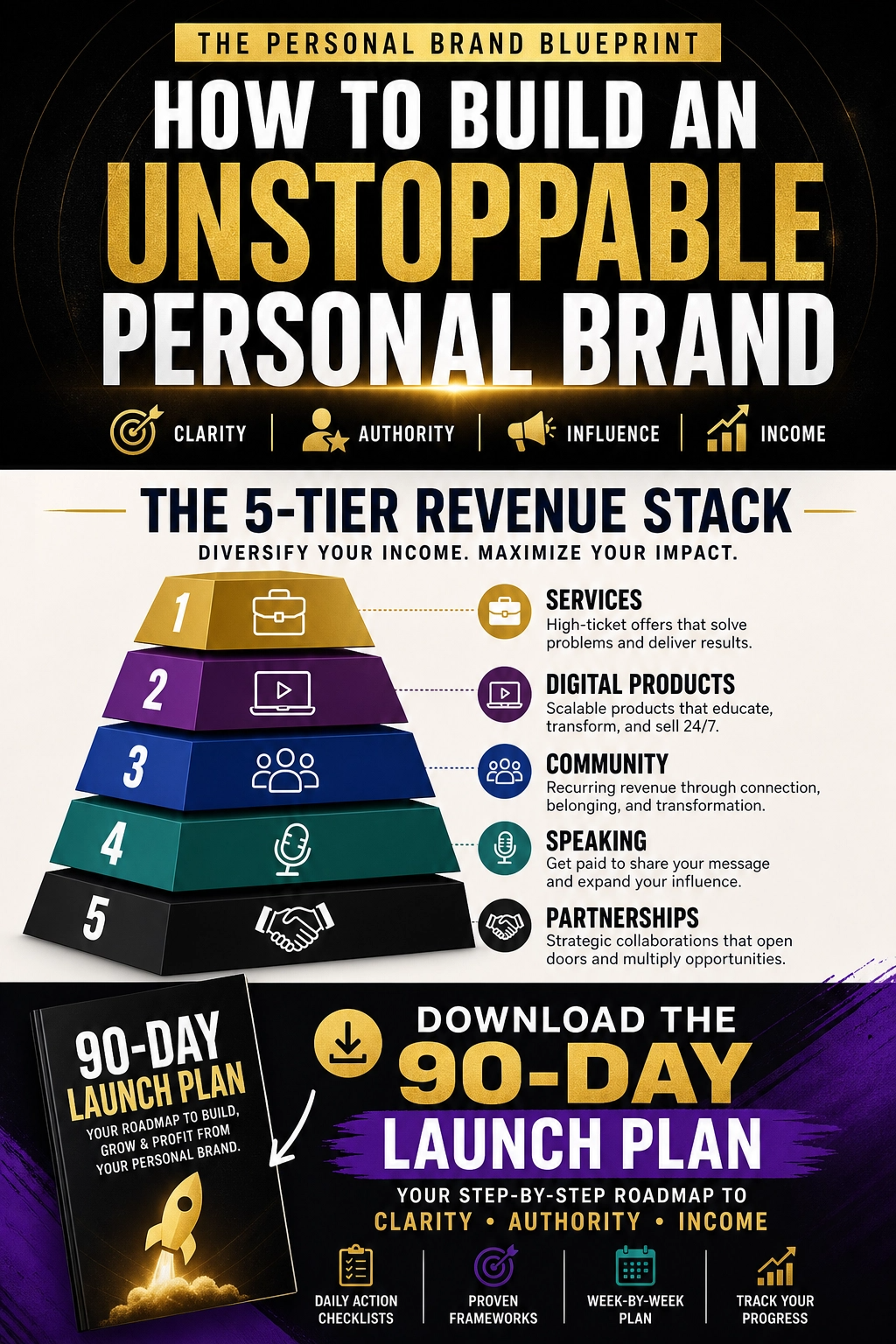
Trust me, a blueprint turns “I’m just posting content” into “I’m building something.”
Final Thoughts
The biggest names in the creator world are acting like business owners because that’s where lasting value lives. You can do the same at any size. Own your audience, diversify your income, document your systems, protect your work, and choose partners carefully. A personal brand gets attention. A business built around it keeps working when the algorithm changes.









Leave a Reply