


Have you ever had one of those days where everything just clicks? You wake up on time, knock out your most important task before lunch, and go to bed feeling proud of what you accomplished.
Now compare that with the days that feel like a blur: you’re busy from sunrise to sunset, but you can’t point to a single thing that moved your goals forward.
The difference usually isn’t talent or willpower. It’s a daily routine.
In this guide, I’ll show you how to build a productive daily routine from the ground up. Not a rigid “5 a.m. or bust” schedule, but a flexible rhythm that works for your life, your energy, and your goals.
Why a Daily Routine Matters
Routines work because they remove decisions. Every choice you make during the day, from what to wear to what to work on first, uses a little bit of mental energy. When your day has a predictable structure, you save that energy for the things that matter.
A good routine can help you:
- Start your day with purpose instead of reacting to notifications.
- Build momentum through small wins.
- Protect time for your priorities before others claim it.
- Reduce stress because you know what comes next.
- Create consistency, which is the real secret to long-term results.
The key word is good. A routine that doesn’t fit your life will collapse within a week. So let’s build one that does.

Step 1: Know Your Energy Pattern
Before you copy someone else’s morning routine, figure out your own natural rhythm. Ask yourself:
- When do I feel most alert and focused?
- When does my energy dip?
- Am I a morning person, a night owl, or somewhere in between?
- What time of day do I do my best creative thinking?
Track this for a week. Jot down your energy level (1 to 5) at three points: morning, afternoon, and evening. If you want a tool for spotting patterns, the Mood Tracker Journal makes it easy to see how your mood and energy shift across days and weeks.
Once you know when you’re at your best, protect that time for your most important work.

Step 2: Design a Morning That Sets the Tone
The first hour of your day shapes the rest of it. You don’t need an elaborate ritual; you need a few intentional habits that help you feel calm and in control.
A simple 30-minute morning routine
- Wake up at a consistent time. Consistency beats earliness.
- Hydrate. A glass of water before coffee is an easy win.
- Move your body. Even five minutes of stretching wakes you up.
- Reflect or journal. Spend a few minutes thinking about what you want from the day.
- Review your plan. Look at your top priorities before you open email.

For step four, the Daily Future Self Journal is a beautiful way to begin the morning. It prompts you to think about who you want to become and choose one action today that moves you closer.
If you’re short on time, try the 10 Minutes to Let Your Mind Reflect, Joy & Thanks journal. Ten quiet minutes of gratitude and reflection can shift your mindset before the day gets noisy.

Avoid this: reaching for your phone the moment you wake up. Scrolling lets everyone else’s agenda in before you’ve even considered your own.
Step 3: Plan Your Day in Five Minutes
You can’t be productive without knowing what “productive” looks like today. Each morning (or the night before), write down:
- Your top 1-3 priorities. What must get done?
- Your time blocks. When will you do each task?
- Your “if time allows” list. Nice-to-haves that won’t ruin the day if they wait.
The Work Day Organizer gives you a clean layout for exactly this. You can list priorities, schedule your hours, jot notes, and track what you finish, all on one page.

Keep it realistic. Most people overestimate what they can do in a day and underestimate what they can do in a week. Aim for three meaningful wins instead of ten half-finished tasks.
Step 4: Do Your Hardest Work First
Mark Twain is often credited with the advice to “eat the frog”: do the task you dread most first thing. Whether or not he said it, the idea is solid. Your willpower and focus are strongest early in your work session, so use them on your most important task.

Here’s how to make it work:
- Choose your frog the night before. Decide what the most impactful task is.
- Block 60-90 minutes of uninterrupted time.
- Turn off notifications and close extra tabs.
- Start with a tiny first step. “Open the document and write one sentence” is easier than “write the whole report.”
When your biggest task is done by mid-morning, the rest of the day feels lighter.
Step 5: Structure Your Workday With Time Blocks
Instead of letting your day happen to you, divide it into blocks with specific purposes:
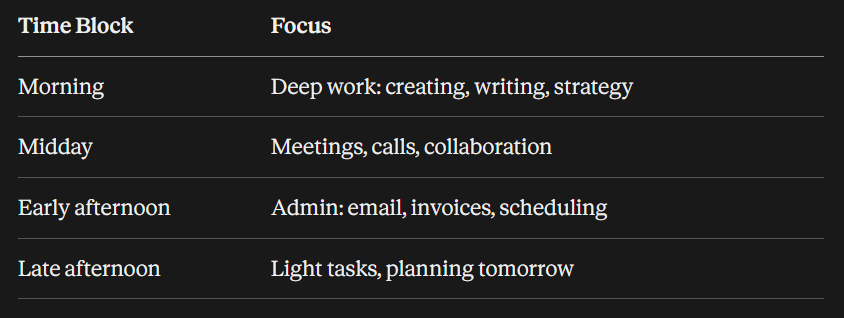
Your blocks will look different depending on your job or business. The point is to group similar tasks and protect your best hours for your best work.
Handle email on purpose
Email is the great productivity thief. Instead of checking it constantly, set two or three windows per day to process your inbox. If your inbox needs a system, the Inbox Tracker (Editable in Canva) helps you keep track of messages that need replies, follow-ups, and decisions, so nothing gets lost.

Take real breaks
Working for hours without a break leads to diminishing returns. Try the 50/10 rhythm: 50 minutes of focused work, 10 minutes away from your screen. Stand up, stretch, refill your water, look out a window. Your brain will thank you.
Step 6: Build Small Habits Into the Day
A great routine is built from tiny habits repeated daily: drinking water, taking a walk, tidying your desk, replying to messages at set times, reading ten pages before bed.
Start with just two or three. Trying to change everything at once is the fastest route to burnout. Use the Mini Habit Tracker Journal to check off each habit as you complete it. Watching your streak grow is surprisingly motivating, and it keeps you honest on the days you don’t feel like showing up.

Step 7: End Your Workday With a Shutdown Ritual
How you finish your day matters as much as how you start it. A shutdown ritual signals to your brain that work is over so you can truly relax. Try this five-minute routine:
- Review what you accomplished. Check off completed tasks and celebrate small wins.
- Move unfinished tasks to tomorrow or later in the week.
- Choose tomorrow’s top priorities.
- Clear your workspace. A tidy desk makes tomorrow’s start easier.
- Say a closing phrase, like “Work is done,” and mean it.
If you need a place to unload lingering thoughts, a quick page from the Brain Dump Worksheets can empty your mind before you leave work mode.

Step 8: Create an Evening That Recharges You
Your evening routine sets up tomorrow’s success. Consider:
- Dinner and downtime. Eat something nourishing and give yourself a real break.
- Screen boundaries. Aim to put devices away 30-60 minutes before bed.
- Gratitude or reflection. Write down what went well today.
- Prep for tomorrow. Lay out clothes, pack your bag, and glance at your calendar.
- Consistent bedtime. Sleep is the foundation of productivity.
Don’t underestimate sleep. Pushing through exhaustion costs you more time than it saves, because tired brains work slowly and make more mistakes.

Sample Daily Routine (Customize It!)
Here’s an example to borrow from and adapt:
- 6:30 a.m.: Wake up, water, stretch
- 6:45 a.m.: Journal and review priorities
- 7:15 a.m.: Breakfast and get ready
- 8:30 a.m.: Deep work block (top priority task)
- 10:30 a.m.: Break and snack
- 10:45 a.m.: Secondary tasks and meetings
- 12:30 p.m.: Lunch away from your desk
- 1:15 p.m.: Admin, email, follow-ups
- 3:30 p.m.: Light tasks and planning tomorrow
- 4:30 p.m.: Shutdown ritual
- Evening: Family, hobbies, rest, wind-down routine
- 10:00 p.m.: Lights out
If you have kids, a day job plus a side hustle, or an unpredictable schedule, adjust the times but keep the structure: intentional start, focused middle, clean finish.
Common Routine Mistakes (and Fixes)
Mistake: Copying someone else’s routine. Fix: Start with your energy pattern and your responsibilities.
Mistake: Making it too long or complicated. Fix: Begin with a 15-minute morning and a 5-minute shutdown. Build from there.
Mistake: Quitting after one missed day. Fix: Adopt the “never miss twice” rule. One slip is life; two starts a new habit.
Mistake: Ignoring flexibility. Fix: Plan buffer time and have a “minimum version” of your routine for chaotic days.
Mistake: Forgetting rest. Fix: Treat downtime like a non-negotiable appointment.

How to Stay Consistent
- Start small. Add one new habit per week.
- Track your progress. What gets measured gets done.
- Review weekly. Ask what’s working and what to adjust.
- Be kind to yourself. Productivity isn’t perfection.
- Celebrate wins. Reward yourself for hitting milestones.
Final Thoughts
A productive daily routine isn’t about squeezing more into your day. It’s about making room for what matters, protecting your energy, and showing up consistently. Start with one change this week, like a five-minute morning plan or an end-of-day shutdown, and let it grow naturally.
Ready to build your routine? Grab the Work Day Organizer for daily planning, the Daily Future Self Journal for a purposeful morning, and the Mini Habit Tracker Journal to keep your habits on track.










Leave a Reply